
Life happens. A sports injury. A deep cavity that went too far. An old root canal that finally gave out. However it happened, you’re now facing a gap in your smile. First thing’s first: take a breath. This is incredibly common, and modern dentistry gives you more good options than ever before.
At Dental Distinction in Chester Springs, we see patients with missing teeth every week. Let’s walk through the three main paths for replacing a single missing tooth, so you can understand the trade-offs before you even sit down with Dr. Petkevis.
Option One: Do Nothing
Technically, this is an option. But we wouldn’t recommend it.
When you lose a tooth, the surrounding teeth start to shift toward that gap. Your bite changes. Chewing becomes less efficient. Over time, you can lose bone in that area because the root is no longer stimulating the jawbone. That can change the shape of your face and make future replacement much harder.
Leaving a gap isn’t free. It just costs you in other ways.
Option Two: A Fixed Dental Bridge
A traditional bridge fills the gap by anchoring a replacement tooth (called a pontic) to the two neighboring teeth. Those neighboring teeth get shaved down to hold crowns, and the whole thing is cemented into place as one solid piece.
The upsides: Bridges are a time-tested solution. The process is relatively quick, usually two appointments over a few weeks. And they feel stable and natural once they’re in.
The downsides: We have to grind down perfectly healthy adjacent teeth to support the bridge. Those teeth will now need crowns for the rest of their lives. Also, bridges don’t replace the root, so the bone under the missing tooth slowly shrinks over time. A bridge typically lasts 10 to 15 years before it needs replacement.
Option Three: A Dental Implant
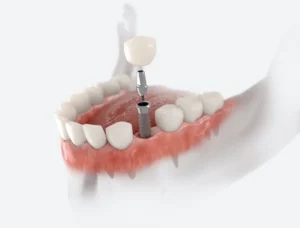
An implant replaces both the tooth and the root. We surgically place a titanium post into your jawbone, wait a few months for the bone to fuse around it (a process called osseointegration), and then attach a custom crown on top.
The upsides: Implants preserve your jawbone because the post stimulates it just like a natural root. We don’t have to touch your adjacent teeth. With good care, implants can last 25 years or more, often a lifetime. And they feel and function about as close to a natural tooth as modern dentistry can achieve.
The downsides: The process takes longer, usually several months from start to finish. It requires a surgical procedure. And the upfront cost is higher than a bridge.
So Which One Should You Choose?
That’s the question we can’t answer without seeing you. But we can tell you what we consider when helping patients decide.
- First, we look at the health of your adjacent teeth. If they already have large fillings or crowns, a bridge might make more sense because we’re not sacrificing perfect teeth. If they’re healthy, we’re much more inclined to recommend an implant.
- Second, we consider your overall health. Implants require adequate bone density to support the post. If bone loss has occurred, we might need to build it up first. Certain medical conditions can also affect healing.
- Third, we think about your long-term goals. If you want the most durable solution that preserves your bone and avoids touching other teeth, an implant is hard to beat. If you want something quicker and less expensive upfront, a bridge might feel right.
We’ll Guide You Through It
We’ll never pressure you into one option over another. Dr. Petkevis will explain the pros and cons specific to your smile, answer every question, and help you weigh the costs and timelines. Our whole team is here to support whatever decision feels right for you.
And if you choose an implant? We’re proud to say Dr. Petkevis has achieved Fellowship status in the International Congress of Oral Implantologists. That advanced training means you’re in experienced hands.
Ready to talk about filling that gap? Give our team a call at 610-904-9274 or request an appointment online. We’ll help you find the path forward.